Get Creative

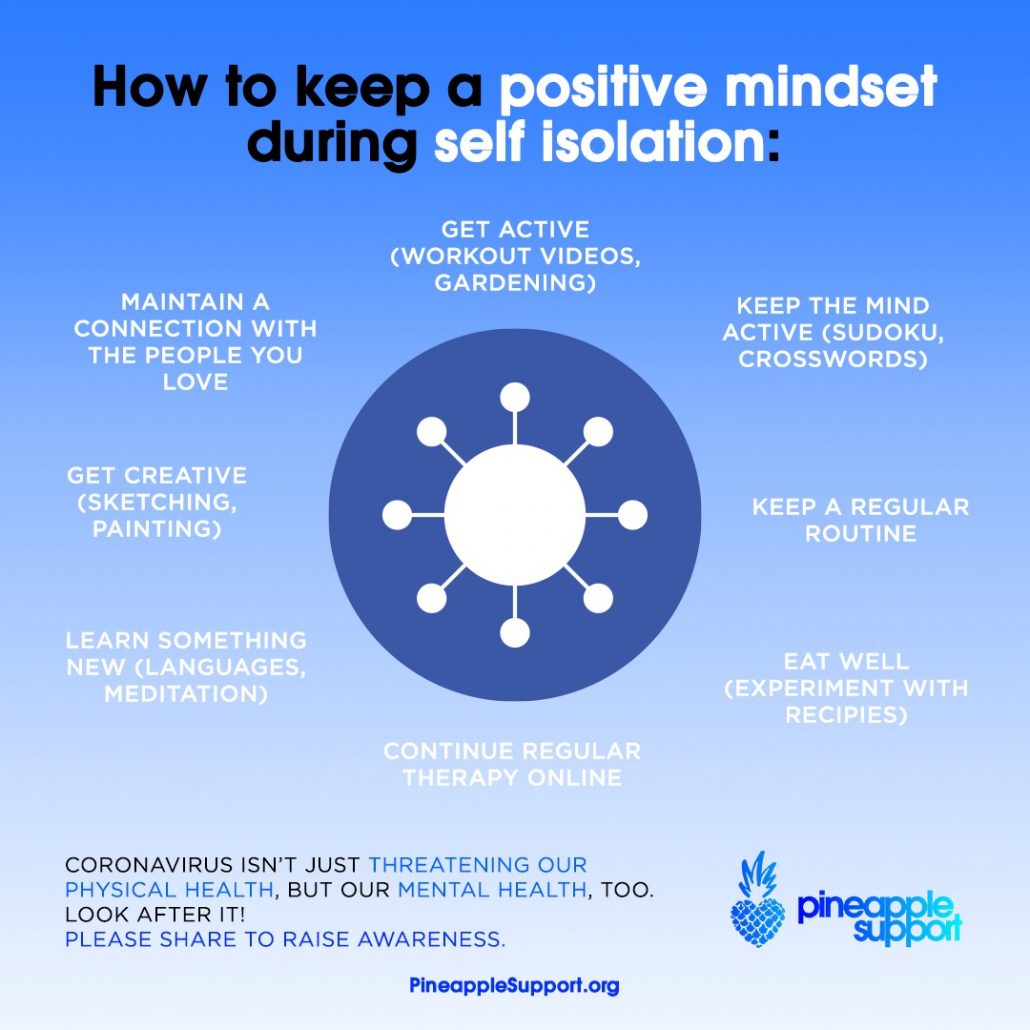
Pineapple Support is an organization that is based upon communication and human connection. The world is now in a situation where this connection is not always possible, many of us have been left with a lot of spare time on our hands and are unsure of what to do with it.

Getting creative, whether it be art, writing, sewing, baking or any other craft, is a great way to keep the mind active and possibly learn a new skill. You may even find a talent you never knew you had.

Crafting and getting creative have a number of benefits for our mental health, including stress reduction; a way to regulate strong emotions such as anger; self-efficacy improvement; and a reduction in your chances of developing mild cognitive impairment, among other things.

Focussing on a craft can also take the mind off the current news and headlines, which is something we all need to do to care for our mental health and well-being.


Below is a list of websites offering tutorials and ideas for getting creative during isolation.


We would love for you to share with us your creations or ideas for others to get creative via Twitter @pineappleYSW


With love, Leya Tanit


Resources

https://www.realhomes.com/news/7-craft-ideas-to-try-while-in-social-isolation

https://www.huffingtonpost.ca/entry/crafts-bored-in-quarantine_ca_5e78fa23c5b6f5b7c548f2f9?guccounter=1&guce_referrer=aHR0cHM6Ly93d3cuZ29vZ2xlLmNvbS8&guce_referrer_sig=AQAAALkd2efUtx7PXAu4i-ocsXOELSD0Yep7QDOVcvZxG3UVAm5189zZ3XS3FCRMOQH_uI4RrAcbuN5fapWFXvbQxIzbV-F6rhihJH4IsXJyqwu2q5juA-7RTl9md48u748qtERNmHJBWJFAHOAHAghp7xFS_RLH9fkBAC0B-Y0q97MS

https://www.craftscouncil.org.uk/articles/up-skill-in-isolation-online-craft-classes-you-can-do-from-home/

https://www.marchnetwork.org/creative-isolation

4 Ways to look after yourself in a crisis

Hello you, how’re you feeling at the moment?

I’m honest with you, I’m feeling overwhelmed by this worldwide crisis and by all the information my mind, body, and soul gets fed with. I try to stay positive and see the crisis as a chance but some days it is more difficult to stay positive than others.

This is why I have decided to write some positive and uplifting words to show you that you are not alone in this situation and that there are options to create positive emotions and rituals in a time of uncertainty.

So what can you do if you feel anxious and overwhelmed? How can you find a way to ease your mind?

Here are 4 ways you can try

1. Limit news and social media

It is important to stay informed but it can get too much for our mental and physical health to digest all this news. The fact that most of the news you see at the moment is negative can grow fear, anxiety, and depression.

So why not limit your daily news and social media consumption?

Instead of listening to the news or scrolling through social media in the morning and evening, create a nourishing morning ritual and a soothing evening ritual. This will help you to start your day energised and to fall asleep less worrying.

2. Routine

In times of change and uncertainty, it is important to have a daily routine. A daily routine can help you to cope with the change, easing anxiety and stress. The routine you create for yourself can be your anchor and can make you feel grounded. By incorporating positive daily habits and self-care into your daily routine your mental and physical health will profit.

What could you incorporate into your routine?
Movement
Meditation
Yoga
Morning + Bedtime ritual
Healthy diet
Time to unwind and relax
Time with your loved ones

3. Connect + communicate

As we are all in this together, it is important to connect with people you feel safe, held, grounded and loved. Even if you can’t see our loved ones physically, you can meet them virtually. You can call them, video call them, e-mail or even write them a letter.

Organise and schedule coffee/tea dates with your friends or a loved family member. You can schedule a date to practice yoga, meditation or a fitness workout with your best friend or training buddy.

Create an online book club, an art class, coffee club, music class, etc. There are no rules, so let your imagination flow and create something to connect with each other 🙂

4. Be kind and compassionate – Loving-Kindness Meditation

I want to invite you to close your eyes and take 20 minutes for yourself to listen to this loving-kindness meditation from Kristin Neff:

https://self-compassion.org/wp-content/uploads/2016/11/LKM_cleaned.mp3

As words are so powerful, try to repeat these words every day:

May I be safe
May I be happy
May I be healthy
May I live with ease

We’re all different and we all have different needs, so it is important to find your way to take care of yourself. I recommend that you try out different things and see how you feel. How do you already care for yourself mentally and physically? Is there something new you want to try?

I also want to tell you that whatever you are feeling at the moment is okay. Try to talk to someone if your anxiety or stress gets overwhelming. I think it is really important that we talk, help and take care of each other.

I hope you liked this article. If you have questions, inputs or want to schedule an online session with me, I would love to hear from you: therapy@denise-wolf.com

Written by Denise Wolf

denise-wolf.com

Life & Sex-Work Has Led Me To Sobriety by AnnaTame

Ever since I hit the end of my elementary school years I started smoking cigarettes. Very shortly after that, it carried onto marijuana, (which I don’t believe is a bad drug or addiction) and then I was introduced to heavy drugs along the way such as MDMA, LSD, Mushrooms, Cocaine, etc. At the time I was in my early high school days when this happened so I was very unaware of a lot of things about drugs in general compared to now. Although, even at the time I was doing these drugs I didn’t care too much about it because it became an escape for me and a way to have fun with my friends.

Fast-forwarded to years after high school, something very traumatic happened to my health. At the time right before this happened I was still smoking daily A LOT, drinking alcohol and doing quite a bit of psychedelics almost every weekend. I was in college for a short business-related program so the partying was normal, but I was like that even before. Being high all the time became normal to me.

I won’t go into depth about what happened to me, but let’s just say it seriously opened my eyes to how important health is, how unpredictable life is and that taking care of yourself is needed a lot more than we think. It wasn’t even just the drugs though, it was everything. My mental health and the way I was dealing with personal issues for years were not helping me.

I’m not here to tell people how to live their lives, we are free to do what we want and indulge in what we want as well. I’m just here to share my story to hope it’ll be somewhat relatable at least or eye-opening. I can only speak from my own experiences so I know that overdoing it could have dire consequences.

This experience forced me to quit bad habits that were unhealthy for me. I stopped smoking, drinking and doing other drugs altogether. Then once I was feeling a bit better I tried to go back to my same ways and my body was rejecting it. So I made a choice to just stop doing everything. That has lasted years. I haven’t smoked at all or did any of the drugs I listed above since.

However, the drinking was still something I could do in moderation, and started back up again afterward. This lasted up until last year around May. I’d use any excuse to do it. But whenever I used it when I was going through something bad, it never made anything better in the long-term. A bit before this I started seeing a practitioner, going to therapy to better understand my thoughts and kept bettering my diet. So naturally, I just decided it was time to either stop or cut down.

I haven’t had a drink in about 10 months now. If I make it a few more months it’ll be a full year. I have never in my entire life since I was addicted to anything substance wise been sober for that long, ever. Will I drink again? Perhaps. Maybe. I don’t know. But I do know my boundaries now from with myself and what isn’t healthy so if I do decide to I’m hoping it’ll be under control or in moderation. Being honest is important because we’re all human here. All I know is that I have cut down on A LOT over the years on a lot of unhealthy things and that’s something to be proud of.

As “corny” as it may sound, all of those things have highly improved my life, and not only that but entering the adult industry has vastly helped me grow as a person and into my sobriety. I may have stopped using years ago, but when I was coming more into myself sexually, it has made me a better person. I started to tap into doing things I’m good at: connecting with others, making a space that’s non-judgemental to be in for both parties and to just be free. Sex work has given me that and I’m very grateful because of it. Whenever I think of wanting to use again, I think of how far I’ve come and how much better I’m off without it.

Without going through these changes, I wouldn’t have changed my lifestyle and found a job I’m passionate about. I love being a sex worker and being one and remaining under control with my unhealthy addictions is saving my life. I’m here to tell you first-hand that although my traumas led me to tough experience(s), it brought me right here. To becoming a healthier person through sobriety and finding sex work unexpectedly as a healthy way to make a living while expressing myself for who I am.

So to anyone who got this far here, this is only a small glimpse of my life experiences and if you knew every detail you’d know how resilient I am. However, I’m just another person who has gone through trauma and addiction but is still here living my life. More importantly, living it better than I could have ever thought was possible.

Written by AnnaTame
Follow AnnaTame on Twitter @annatame69

My Story by Kena Love, with advice from therapist Nicki Line

I’m one of the many people who follow your tweets on twitter and I just had to write ya a quick email in regards to addiction and sex work for myself. See unfortunately they both go hand in hand. I can’t do dates without being high. And now I get paid to had sex just to support my habit. It wasn’t always that way. At first it was a high in itself to be wanted so badly by men who wanted to pay big $ to fuck me. But when my friends realized what I was doing I began to hate myself a Lil bit more every day. First came opiates but when I take them I can’t get turned on/wet/ or cum at all. That’s when I was introduced to meth. First time I did it I was hooked. I fucked for hours . My orgasms were amazing and all I could think about was getting that next on hit and dick.

Hello Kena,

I agree with you that the sex industry does have a high rate of individuals who struggle with addiction in one form or another. Let me start my response by defining addiction as I understand it. Addiction is an obsessive compulsive out of control behavior done in spite of negative consequences for self or others. Under this definition any behavior can be an addiction whether it is sex, shopping, food, or substances. While reading your email the stages of addiction and the cycle it can keep a person in comes to mind: initial use, abuse, increased use, dependency, and relapse. You describe “at first is a high … to be wanted so badly by men” which started the process of looking for an outside person or thing to regulate an internal issue. It felt good and distracted from other feelings in the initial stage. Then you started to have an internal conflict of your work and self-worth, to numb those feelings you started taking opiates and the opiates numb feeling as well as your body. Continuing to search for an external cure you tried meth which gives you a feeling of euphoria and increases sexual desire which switched your reward center in your brain into overdrive. This is where you need to increase your use to get the high or reward you felt the first time; which will never happen because you have already experienced it once. Now you are used to the combination of work and meth and you are dependent on them to function “normally.” I imagine it is hard to working without the meth and when or if you try you crave the substance which leads someone to relapse. You are correct in that it is a cycle and it is a cycle anyone can break if they learn and use new tools in recovery. Recovery is not easy and requires a person to develop new coping skills to use instead of the obsessive compulsive behavior. I will go into more detail about all of the topics I have touched on above in the Pineapple support group on Sundays. I hope you keep fighting for yourself.

Sincerely,
Nicki Line LMHC CST

Acknowledging my Addiction – by Rogan Damiana

Addiction has affected me in some way my entire life. Starting with family members who had problems with addiction to my own issues with substance control in my adult life. I didn’t used to think I had a problem. Drinking was a massive part of my social interaction. Alcohol allowed me to be “fun”. At least that is what I told myself. I didn’t drink during the day; I wasn’t missing work or life events. I just partied hard when I did socialize until the partying turned into an every evening event.

I would immediately start drinking most nights when I got home from work and continue until I could no longer stay awake. Binge drinking was something I had heard of but was not associating with myself.

This destructive path of using binge drinking to cope with my complete unhappiness with my life finally culminated in a very nearly successful suicide attempt in April 2018. I had decided I was done trying and overdosed on my anxiety meds plus a gross amount of alcohol. I will never forget the jarring feeling I had waking up in the ICU, then reading my discharge papers detailing my overdose. It was in that moment I knew I had to change my destructive behavior.

The sense of comfort alcohol provided was false. It was wrecking my body physically and causing more stress mentally than it was relieving. I had allowed alcohol to bring out the worst of myself, hurting the people around me who loved me. The amount of money I wasted on numbing myself is staggering. I can think of so many more meaningful ways I could have used that money. Getting unstuck from negative thought patterns like that has helped me to move forward.

Staying sober from alcohol has not been easy but forgiving myself for the mistakes I made helps with the process. We can not change the past. I can’t take back the hateful words I used or actions I took out of anger with myself. The effects of my actions will always be.

For me recovery is changing the way I live. Through therapy and my small circle of support, I work consistently to change my thinking. The biggest challenge I have faced in this process is liking myself. Redirecting my perspective to acknowledge the positive aspects of my life and accomplishments helps combat the negative self-talk. When I start to get overwhelmed, I remind myself that I am doing everything possible to fix my life and that change takes time. There is already a noticeable difference in how I handle adverse situations that come up. Instead of immediately intoxicating myself to avoid dealing with the negative, I think through what actions I can take to make things better.

My social life has changed considerably since stopping my alcohol use and I have learned to be ok with that. Watching people I used to spend a lot of time with drift away has been hard. I hold no bad feelings towards this, relationships shift and change all the time. While being around others who are drinking is not a trigger for me, I have found I do not enjoy those environments anymore. I don’t hold that in common with those people that were in my life previously.

I also found that I had to strengthen my confidence in letting people know I do not drink. While to me it isn’t an issue that I don’t drink, I have received a variety of reactions when telling others. When I started this journey I would feel uncomfortable turning down a drink when offered because of the follow up questions that frequently followed. The well meaning “oh, one drink won’t hurt”, “but you’re so fun when you drink”, and my least favorite to deal with the misguided pity responses. In my ideal world just saying no would be enough. When pressed I generally reply with “Alcohol and I do not agree anymore” and leave it at that. I still go out; I still like to see live music and art shows. Now I do it without masking my anxiety with alcohol. I take a minute to go outside if the crowd is overwhelming. Also, allowing myself to be ok with

leaving an outing earlier than others helps so much. I enjoy myself and when I’m out of social energy it is time to go home. Putting my health and well being first felt weird in the beginning, but soon became a habit I don’t even notice anymore.

Addiction looks and feels different for all of us. It is a very personal issue to deal with. I hope sharing my story and how I handle this continuing journey will bring some hope. It is possible to survive after addiction and while it isn’t always easy, keep going. There will still be days that suck and challenge you. Every small change you make to create a better life for yourself will pay off. The proof I have to offer is myself. I am still here, still breathing, still trying, and succeeding. I hope this gives you the energy to try too.

If you would like to contribute to addiction month, please submit your article or video to contact@pineapplesupport.org

Submissions can remain anonymous.

5 Things to Remember in Early Sobriety

Kristie Overstreet Ph.D., LPCC, LMHC, LPC, CST

So here you are in early recovery. You’ve decided to get sober, and you’re feeling okay most days. You know that the tough times are coming, and early sobriety isn’t easy. Here are the five things to remember in early recovery to help you stay sober.

1. Fill your downtime
Especially in early recovery, it can be hard to have downtime. Your substance use consumed your time, and now that your sober, what will you do with the extra time on your hands?

Avoid idle downtime by filling your schedule with things to do. Whether it’s visiting friends, going to a 12-step meeting, or working on your to-do list, don’t sit around aimlessly. Your addiction is wanting you to give it an excuse to use, which can be avoided by staying busy.

2. Get back in touch with your hobbies
Many times in active addiction, it’s easy to lose touch with the things you use to enjoy doing. Now that your sober, you have more time to enjoy hobbies or things that interest you.

If you are struggling to remember what these are, think back to what you enjoyed doing growing up. Did you play video games, draw, or play the guitar? Have you wanted to try something new like painting, yoga, or getting a pet? Try making a list of things that interest you and pick a new one each week. Hobbies will help you find enjoyment in the little things that you use to not have time for.

3. Get active
Your body wants to move, and being active in your sobriety is a great coping skill. Your brain used to be stimulated by substances that released feel-good chemicals, and now that they are not triggered, you’ll need to access them through exercise.

Sure, you can’t 100% simulate the high you received from your substance of choice, but being active can access the same area of the brain. Have you ever heard of a runner’s high? It’s the feeling you get after running that makes you feel like you are on top of the world. Find some form of exercise or physical activity that you enjoy.

4. Find your triggers and how to cope
Everyone has different things that trigger them to one to use. Whether it’s people, places, or things, you need to know which ones to watch out for in your recovery. Make a list of things that make you want to use your substance of choice. No matter how small or large they are, add them to the list.

After you have listed your triggers, then identify a coping skill you will use with each of them. For example, going into a particular place where you used may be a trigger for you. One coping skill is to avoid the location for a while, or you will have someone who supports your recovery with you when you go there. Knowing your triggers and how to cope with each of them will help you stay sober.

5. Surround yourself with support
The more supportive people you have around you, the better chance you’ll have in early recovery. Whether it’s friends, family, a sponsor, or other sober people, remember that you are not alone.

You will feel like you’re the only one, so avoid being alone and isolative. Force yourself to get outside and around others. Challenge yourself to reach out to one person each day, even if it’s only a few minutes. Doing this will keep you in the habit of staying connected.

Recovery from your substance of choice is hard, but you’ve done harder things in your life. Your sobriety will be challenged daily, so you’ll have to recommit each day you wake up. As time goes by, it will get easier, but you’ll need to stay focused on doing what’s right for you and not those around you.

Taking it one day at a time can be too difficult, so break it down to one hour or one minute at a time. Your future is worth it, and you can’t have it while you are in active addiction.

How do I know if I’m an addict?

The word “addiction” is a strange one. It’s thrown around everyday speech like it’s a normal everyday occurrence. We’ll hear people say, “Oh, I’m addicted to Netflix” ….. “I’m so addicted to chocolate / buying shoes”….and so on and so on. But we shouldn’t really be saying that, because addiction in its most serious forms is a silent killer, and a mental, physical, emotional and spiritual illness, affecting every part of our being – and our loved one’s too.

So how do we know if we’re an addict? Surely everyone is addicted to something, and if everyone is doing it, then it can’t be that bad, right? Hopefully this article will give some insight as to how to recognise some of the lesser known signs of addiction.

Primarily, addiction is about consequences – the results of our behaviour. The World Health Organisation recognises addiction is “continuous use despite negative consequences”.

We can trick ourselves into thinking, “well, I didn’t hurt anyone, so what’s the big deal? No negative consequences for me”. But challenge yourself to consider your emotional consequences – shame, guilt, self sabotage, anxiety, depression. Do these things keep happening after you act out on your addiction? Then it’s a consequence. What about the consequences on your family and loved one’s? What would they say about your addiction?

Are you keeping it secret? That’s a consequence. When we really take a fearless, moral inventory of our behaviour, it requires us to take a long hard look at ourselves and can reveal uncomfortable truths.

Amongst recovery circles, there’s a saying, “secrets keep you sick”. Often that’s the pull of addiction – it becomes a secret. Thrilling at first, then as it progresses (and it will because that’s the very nature of addiction) the secret becomes bigger and bigger, until it becomes too big to share.

Denial and comparison are two other things to look out for with our addictive behaviours. These two keep our addiction secret. We’ll often hear people say, “well, I can’t be an addict, because I only do it on the weekends”. But addiction is not about quantity, it’s about the effect that it has on your life and the lives of those around you. There is always a cause and effect to all of our behaviour – even if we don’t know the people who are involved in our acting out.

When we start to look out for our own individual signs of addiction, we’ll often find that the slippery slope to addiction starts with us reacting to the same triggers, whether that’s a person, place or thing. But one thing which is common to all addicts is the sense of wanting “MORE” and not hearing that self-regulation button of stopping. And that’s the definition of insanity – doing the same thing over and over again, yet expecting different results.

Hopefully this article gives more of an insight rather than a directive as to where you’re at with your own journey of addiction. Remember – if in doubt, speak it out. There is always someone who has been on a similar journey. Promise. X


Written by Camilla Simpson

My Approach To Trauma

Serious emotional trauma results in post-traumatic stress, perhaps even PTSD. You experience “flashbacks” where you are hijacked by the past. A scent, a sound, or a vivid reminder of your trauma triggers an instantaneous feeling that you are back there–even if you know rationally you are not. How do you deal with this?

The first step is “grounding” to help you stay in the present. When you are triggered, can you name five things you can see and five things you can hear? Can you feel anything, perhaps the chair you are sitting on or the temperature of the room? Can you smell anything? Really concentrate on your surroundings. If you have difficulty with this, try something more drastic such as sucking on a lemon or listening to loud music. Or you might carry a stone in your pocket, something hard and firm that can help pull you back to the present.

Another helpful practice is mindfulness meditation. Contrary to popular belief, it is not about relaxation, but rather its opposite: heightened awareness of the present. You learn to sit with with difficult feelings and thoughts as they arise and then dissipate by focusing intently on your breath or some outside stimulus such as a clock ticking.

In therapy, we deal with the toxic self-messages linking past trauma to present triggers. They probably happen so fast, you don’t notice them, but they are there. The scent of cologne might trigger a powerful memory of sexual abuse, for example. Immediately you replay the thoughts from your trauma, thoughts like: “I led him on. It was my fault.” And the thoughts lead to intense feelings of powerlessness, violation, and self-blame.

What are the thoughts you tell yourself when you are triggered? “I’m powerless”? “I’m to blame”? “I deserve this”? Thoughts like these may not only trigger you, they may also cause you to stay in an abusive relationship or be taken advantage of. How do you challenge them?

I might invite you to reflect on situations where those messages do not apply. I might suggest you come up with positive messages you know are true. I might question whether you would tell a friend in a similar situation that he or she deserves it. Are you horrified at the thought? – Then stop doing it to yourself. Find positive, healing messages to tell yourself instead.

Reminders of past trauma may always bring up painful memories. But if you can challenge the toxic messages associated with those memories, you can remember what happened without reliving it.

You can’t undo the past and “heal” the trauma you suffered. You cannot get back the life you once had. But out of its shattered remnants you can build something healthy, something wonderful, something beautiful.


Russell Stagg

Where do we fit in?

Mass violence. Hurricanes. Shootings. Rape. Abuse. Assault. Earthquakes.

Where do we fit in?

According to the Federal Bureau of Investigation (2017) violent crimes increased nationwide in 2016 by 4.1 percent and homicides rose by 8.6 percent. During 2015 – 2016 violent crimes have experienced an uptick by twenty – percent, which is puzzling, yet terrifying at the same time. Children, adolescents, and young adults have more access to hear the exact details and updates on carnage and crime due to technological advances. According to the Veteran’s Administration (2017), within a week of September 11th, 2001, individuals reported watching around eight hours of media regarding the attacks, mostly focused on digital media, which includes images and videos.

According to Forbes (2017), there has been an increase in the intensity of category four and five hurricanes, but not the amount of hurricanes. Therefore, even though there are “less” hurricanes, the ones that make landfall are causing prolonged trauma, distress, and disruption of our lives. The never-ending warnings, updates, and sensationalism of news coverage of hurricanes can greatly impact survivors’ mental health, as it keeps individuals in a constant state of fight, flight, or freeze. Individuals who consume more social media focused on disasters experience higher stress responses, increased hopelessness, a fixation on death and injury, and higher rates of PTSD symptomology (Rogers, 2016).

With the recent and more historical episodes of mass violence, including the Dayton shooting and the El Paso massacre, there is a question on all of our minds: when will we stop beating our own record of “deadliest mass shooting?” The inflation of violence and natural disasters in recent years has many effects, but one thing we have not been discussing is our stunted processing. With so many acts of brutality occurring at a faster pace than ever expected, we are not given the time to properly grieve, mourn, process, and understand these tragedies. Our attention is constantly torn to another tearful catastrophe. Our emotions, memories, and images become unprocessed, leading to the foundations of mental disorders and distress (Shapiro, 2014).

Every day it becomes increasingly challenging to turn away from the carnage. If the television won’t interrupt us while we watch our Monday sitcoms, our phones will inadvertently alert us. If we disconnect from technology in an effort to remain peaceful and sensitized, we can expect a friend or coworker to fill us in on the gruesome details, phone waving in their hand, depicting heart-wrenching images. We are stricken with a sense of vulnerability, and some would even say powerlessness. We are a society that is holding onto our last thread. We are powerful and spirited, yet ground down to our last shred of hope.
We must navigate our social media with grace amidst expedient broadcasts, tweets, and texts about violence in an effort to avoid desensitization, which often leads to hopelessness and symptoms of depression (Rogers, 2016).

There is a cost if we don’t.

Epigenetics is the study of the alteration of genes and their processes (Weinhold, 2006). So what does this have to do with the anxiety and fear we are experiencing or anticipating? Genetic changes caused by individual or community trauma may occur within the family line for more than four generations (Winhold, 2006). Although the studies surrounding transgenerational transmission of trauma have mostly been exploratory, difficult to generalize, and specific, there are still aspects which could affect our future generations.

Although it has been challenging to find out if trauma is truly passed down through the genetic line, there is still an opportunity to negatively influence our future generations. Trauma can be passed down through: family or friends reporting their experience with heavy emotions attached; utilizing negative and catastrophic terminology; a hyper-focus on discussing only the traumatic incidents during the period of tragedy; unresolved feelings of guilt and shame; ongoing anticipation of further disasters; parents living in fear based on identifying characteristics (LGBTQ, black, refugee); and providing technical levels of detail to children before it is developmentally appropriate (Braga, Mello, and Fiks, 2012).

Our unresolved issues can directly affect our children and our children’s children. As we grow, we learn from watching our parents with utmost precision; we speak about and conceptualize our reality in a similar way to how our parents do.
Some parents interact with their children through a preoccupied attachment style, which signifies parent’s engrossment in their own intrusive and damaging life experiences, like mass violence (Shapiro, 2012). This attachment style teaches the child to adopt an aggressive way of being in order to get attention, often resulting in insecurity and dependency later in life.
Other parents may interact in a disorganized attachment style, in which the parent has no boundaries about their psychological trauma. What you may see from this type of parent is anxious behaviors, fearful facial expressions, unexpected emotional outbursts, and haphazard ways of communicating, leaving the child confused (Shapiro, 2012). The child may be unsure and nervous themselves about initiating contact with their parent, as their parent is dually their source of care, yet the cause of their unconscious anxiety (Shapiro, 2012).

We are all at risk, now that we have unexpectedly been cast into the role of captive audience to unforeseen tragedy. However, despite our current feelings, we do have potential. We do have control. We do have hope.

1. Always remember your breath. It sounds arbitrary. It sounds like a platitude. Hearing someone say “take a breath!” can feel obnoxious or demeaning. However, it is one of the smallest, yet most impactful ways we can exert power in our lives. Our breath is one of the few things we can control and access at any time, privately. When overwhelmed, square breathing can help us take a break from racing thoughts. Breathe in for four counts. Hold for four counts. Breathe out for four counts. Hold for four counts. If it helps, imagine a stream of light in your favorite color pulsing through the square as you move through it.

2. Make an impact. In moments of vulnerability and suffering, we forget our abilities. Locate a nonprofit agency of your choice and donate your time, talent, or treasures. Set up a monthly donation of a few bucks. Dedicate an hour a week to volunteering. We may feel like our influence is a “drop in the bucket,” but all we can do is transform people or animals one at a time, setting off a butterfly effect of compassion.

3. Hold onto your routine for dear life. Symptoms of trauma can distort what we hold most dearly, disrupting our ability to focus. Establishing a daily routine can help normalize one’s day-to-day experience, stabilize us, and bring comfort. At the end of a productive day, we end up feeling accomplished and in control, despite the world’s happenings.

4. Create an internal safe place. Allow whatever image that comforts you to come to you. Choosing a place in nature can be a grounding experience. Ensure no people or pets are there as to avoid any upset feelings. Notice the colors, scent, sounds, and imagery. If you looked to the left and right, what would you see? Allow the feelings of security to set in and know you can access this private paradise at any time.

5. Make space for relationships. When we are overwhelmed by the “yuck” of our daily lives, we forget that people care about us. We forget the world cares. How can anyone care if the world is so dangerous? We must avoid buying into the thoughts that drag us further down. Reach out to friends, even if you simply say “Hey, I’m not doing so well, but I wanted to check in with you.” Or “Would you like to watch this movie with me? I need a little distraction and joy today.” Be honest with others and they may be moved to be honest with you.

6. Keep a “thought log.” Thought logs are ways of getting us in touch with our themes, patterns, and triggers in life. When the news keeps rolling in, we have our thought logs to ground us. It may help to jot down the trigger, what thought immediately came up, what you felt when that thought sank in, and balancing it out with an evenhanded perspective. What would your mentor say? What would your higher power say? Connect with that perspective.

Although trauma can be a powerful force, remember: we will be more exhausted by running from trauma than by shocking it and facing it with our strength and willingness. Do it afraid.

written by Rachael Wells

My Abuser Was So Charming, No One Believed He Raped Me

My life consists of helping others, reading dystopian fiction, activism, writing poetry and crafting. Most of these activities have assisted me in coping and healing from the rape I survived when I was 16 years old.

My partner at the time was 20 years old, maniacal and abusive. He was exceptionally talented at lying and cheating. He would monitor my eating by clocking how long it would take, and if I did not hurry, there were extreme consequences.

He cheated on me with five women, and as he told me, he laughed.

In the car, during his giddy story of deceit, I grabbed a sharp item from his glove compartment and began slashing at my wrists. This would not be the last time I self-harmed.

Finally, physical and emotional manipulation and abuse would not suffice. He raped me in his locked room, with his parents just around the corner, so forcefully that the bed looked like a murder scene.

Cheerily, he took the sheets off, put them in the washer and said, “Ha, I sure hope that stain comes out!”

My abuser was extremely charismatic. He is a nurse. When you think of a nurse, I would assume most individuals think of someone warm, welcoming, smiling and compassionate. On the surface, he is all that and more, but it is a finely tuned façade.

The first time I met him, I was dating his best friend. We were all at a mechanic together, waiting for my current boyfriend’s car to be fixed.

He sat down next to me and attempted to get to know me. He was highly flirtatious and said all the right things, things I had never heard before. He told me he could feel the endorphins in the room. I lit up the room with my energy and beauty.

Compelling, poetic words.

I did not feel creeped out by this, surprisingly. He has an energy that makes you feel under the influence, but mostly as if you are buzzed. It is like slipping into a warm, glowing place.

From my description, this sounds exactly like what you might like to feel with someone, anyone. I promise you, you do not. He had this effect on everyone he met.

However, behind closed doors, he was the most manipulative person I have ever witnessed.

He had a sharp grin like a fox. He would smile and dote on me as he delivered the most horrendous backhanded compliments and emotional abuse.

He would look me straight in the eye and tell me he could not take me to the homecoming dance due to lack of funds while showing me his new keyboard, mouse and computer.

It is still hard for me to look at the local park where he hit me, degraded me and brutalized me.

He was an excellent liar. Remarkably so. No matter what pain he delivered, you were spellbound into believing you deserved it and this is how it must be.

He made me feel like he knew what was best for me in the end and was only doing what he did to “make me a better person.”

When I would share this with others, they thought I was nuts. “He is such a perfect guy. He is older, well-established and so friendly… what you are telling me is bullshit,” they’d say.

Little did they know, he checked off all the marks for those likely to be abusive.

I believe my friends reacted the way they did because all of us really had no education on consent, boundaries or abuse. I found out later some of these friends had experienced their own abuse and attempted to curb their feelings by shutting me down.

The biggest reason I was misunderstood and rejected was because my abuser was so full of charisma.

I always tell people, to this day, “You would love being around him. He could even trick you despite your psychological knowledge. He slips past your radar.”

From that brutal event, I suffered from PTSD, which is marked by night terrors, hyper-vigilance, increased stress response, reliving the trauma and avoidance.

From the age of 16 to 17, I abused pills to a degree, had a scathing attitude and was fueled by hatred.

In school, teachers knew something was wrong, but did not try to interfere. I could not have gotten through high school without their willingness to stay their distance.

Because of the uncomfortable fear I felt when I thought about telling my parents what happened, I only told a few friends of mine. This was the right decision for me at the time, but I still wish I had told them at the time it happened because I never got any soothing or healing from my friends, and my traumatic memory seems to be permanently stored in my amygdala.

But at the age of 20, in an act of desperation, I blurted out to my parents what had happened to me. Everything came to a screeching halt. My parents could not simply process what it was I was saying to them.

Their first response was to feel guilty for being the people who brought me to my then-boyfriend’s home. They thought it was their fault for “facilitating the assault.”

I assured them this was not true, but they continued to harp on their wounds: “Why didn’t you tell us earlier?” “Why didn’t you report this?” “Why did I drive you there every week?”

This barrage of guilt-inducing questions made me sick. However, I empathized as best as I could. Hearing what had happened to me so much later likely left them feeling disheartened and powerless to fight back against my rapist.

All of this hurt me.

Over time, they have begun to realize the focus should have been on me, as I had already moved past those terrifying inquiries. Now, they have fostered respect and healing toward my experiences.

Although they are still mystified about it, they try to understand the effects of it by letting me speak my mind and have a healthy amount of space.

Because I never got to openly discuss my trauma until years later, my memory of it is generally fuzzy and I feel like that has caused a stunt of my growth and healing.

My thought patterns and behavior were poor and negative. I tried to control others and hurt them with my words and actions, thinking that I would somehow feel better by doing this.

However, all I can do is move forward with the memory and coping skills I have. Through this, I realized it was time to change and devote myself to protecting and helping survivors.

Now, I am in my second semester in a master’s program for mental health counseling, I am an advocate for survivors and victims, and I constantly champion for social justice.

The rape at 16, and a succedent rape, as well as numerous experiences with sexual assault, sexual harassment and catcalling, have led me to the point where I am today.

Six years later, I am now able to succeed in my field, help others properly, cope healthily, go to counseling and express my feelings and my story without being afraid.

My partner now is wonderful, compassionate, full of love and understanding. I am able to share my story, experience safety and feel comfortable. He listens to me always, about my concerns and my fears.

He is familiar with the symptoms of PTSD, so he never startles me with knocking on my front door or ringing the doorbell. Instead, he sends a text.

He looks at the parent’s guide for movies and television to screen for things like sexual content, vulgar language, violence, misogyny and transphobia.

He makes things for me that soothe me, like a little box that holds kind words of love and how he feels about me. It is to be used when I feel worthless or depressed.

To transition from a victim to a survivor, others need to provide you with time, space, sympathy, active listening, understanding, involvement in your story and the repercussions and, most importantly, nonjudgmental love.

Rachael W