The Benefits of Group Therapy

Have you ever wondered what group therapy is, or what the point of group treatment would be for you? Depending on the issue, joining a group can be a helpful choice for making positive life changes.
Group therapy is a form of therapy where a small, selected group of people meet with a therapist, usually weekly. The purpose of group therapy is to help each person with emotional growth and problem solving. Sometimes a person can do both individual and group therapy, while others may only do a group.
According to Dr. Irvin Yalom in his book The Theory and Practice of Group Psychotherapy identified 11 curative factors that are the “primary agents of change” in group therapy:

1. Installation of Hope: People come to a group to improve their lives. Each person in the group is at a different place in their emotional growth and can offer hope and inspiration to others by showing what they have learned and overcome.

2. Universality: Many who begin group therapy may feel isolated and alone. Being part of a group can help people feel understood and have a sense of belonging. Especially if you are apart of a small niche population such as sex work.

3. Information Giving: A big part of many therapy groups is increasing knowledge of a common problem. This helps members help themselves and others with the same or similar problems.

4. Altruism: The ability to help others in the group is a source of self esteem and increases self worth, especially in those that do not think they have anything to offer others.

5. Corrective recapitulation of the primary family: Some people in group therapy may have stress or conflict in their family. The group can become a form of a family that can offer support and acceptance.

6. Improved Social Skills: Social learning, or the development of social skills, is something that occurs in therapy groups. Members offer feedback to each other about their behavior in ways that can improve relationships both in and outside of group.

7. Imitative Behavior: The therapist models appropriate prosocial behaviors such as active listening, non-judgemental feedback, and support. Over the course of the group the members can pick up on these behaviors and integrate them into their own behaviors. This can lead to improved social skills and self esteem.

8. Interpersonal Learning: Being a group can be an opportunity for members to work on their ability to relate to others and improve relationships.

9. Group cohesiveness: Wanting to belong to a group a main motivation for human behavior. Group therapy can help people feel accepted and valued. This is an important healing factor if members have felt isolated.

10. Catharsis: The release of conscious or unconscious feelings gives members a great sense of relief. Yalom states that it is a type of emotional learning, as opposed to intellectual understanding, that can lead to immediate and long lasting change.

11. Existential Factors: Groups can explore and process issues such as death, isolation, and meaninglessness and help them accept difficult realities.

Joining a group of strangers can seem intimidating at first, however, joining a group can provide benefits that individual therapy alone may not, such as providing a support network. Other group members can help formulate solutions and hold each member accountable for change. Also talking with and listening to others can help put problems in perspective. Others may share similar struggles and give each member the experience that they are not alone. Diverse feedback is another benefit of participating in a group. Each members’ personality and background can help examine problems in different ways. Members can learn many different strategies for tackling issues.

By Nicki Line LMHC, LAPC, CST

The list of Pineapple Support support groups can be found by clicking here

Safety First

Unless you are one of the very few people in the adult industry to be known by your real name, ensuring the safety of your identity is a crucial part of your life. Trusting relative strangers can result in horrendous consequences for not just yourself but also your family!

It has been announced recently that ‘Revenge Porn’ has risen considerably during the first part of this year, with the number of cases already higher than the whole of last year. One government funded helpline has seen an increase of more than 22% from last year and a recent report by Refuge has found that 1 in 7 women have received threats that intimate photos will be shared without their consent.

This year, no doubt due to the coronavirus and the consequent lockdowns has also seen a rise in domestic abuse and whilst it is not only women that are suffering, they are in the majority.

So how do you maintain your job in the adult world and ensure you stay safe now and in the future?

Starting off as you mean to go on is an absolutely crucial part of starting out in the adult industry. Always expecting the worst, utilizing every piece of security available and ensuring you always think first is the best advice you can receive and utilize.

For some though, it’s too late to act as the division between your public and private life has already become compromised. For those people, it seems that their whole world has crashed around them. This is especially pertinent for those working in the adult industry as it still causes upset to family and friends and the level of contempt is disturbingly high.

This can produce an enormous amount of distress to the person concerned and being ostracised for simply earning a living in the adult industry, can be the trigger for depression, melancholy and for some, alarmingly, suicidal thoughts ensue.

Not having any confidential routes to relay and discuss your concerns has been a huge issue for all adult workers, whether or not they work in sex or glamour. This is one of the main reasons that Leya Tanit set up Pineapple Support. Anyone in the adult industry can access their services for support, advice and counselling if required.

They have already provided help and support to lots of people and rely on donations to carry out this amazing work. If you have any interest in helping Pineapple Support, whether it’s with a much needed donation or if you are able to provide time, support or any kind of help, however small, don’t hesitate to get in touch.

https://pineapplesupport.org/

Carla Sez will back soon with more guidance on how to keep your work life safe and your private life secure and protected.

For now, think before you post!

Love All

Carla Sez x

Should you share your Life on Social Media?

Reaching out and providing support at anytime is important but even more so now.

Working from home has never felt so isolating and for most of us, admitting we are lonely and perhaps need help is one of the last things on our mind. For some unknown reason, that feeling of self-worth gets all screwed up in our head and finds its way out somewhat bitter and twisted. Sometimes we believe that everyone else should know how we are feeling, even though they don’t actually live inside our head!

Social media has a big part to play in todays world as we assume that once we have pressed ‘Enter’, all of our friends and all of the friends of those friends will see our post and come rushing to the rescue. The truth is that very few people actually see your latest ‘out-pouring’, and those that do find it hard to accept and respond to such an open form of counselling.

It is also increasingly difficult as you get older to accept help, we seem to revert back to those teenage years where we believed that nobody understood us and everyone was in fact out to make our lives difficult. Being independent is fine (up to a point) but at some time in our lives we all need a little bit of help, or a shoulder to cry on.

Knowing who you can trust and speak to about such personal matters is the first key to being able to cope with any kind of pressure. You shouldn’t wait until you need the help either. Find out who your real friends are by really thinking about your relationship with them.

You may share all the positive things in your life with a group of people or one person in particular and all the negative issues with another. You may even be the type of person who doesn’t ever share anything about their private life with friends ever.

Whichever group you belong to and especially if you are on your own, you do need support from time to time.

Pineapple Support have made it their mission to provide free support and therapy for all persons working in the online adult industry. It doesn’t matter about your gender, sexual orientation, ethnic origin, social status or age. They provide support 24/7 and their team of sex-worker friendly therapists offer face to face, or online therapy to anyone who needs it.

Their ever-growing team are always looking for ways to raise extra funds so that they can provide even more help for professional coaching, therapy and counselling for those who require help and support.

Do what you can to help this amazing cause.

Love to you ALL

Carla Sez x

Pineapple Support To Provide Suicide Prevention Training Presentation

Pineapple Support, the adult industry’s leading mental health resource, will host a free Suicide Prevention training presentation to help those in the adult industry to better understand the mental health issues that lead to suicide, including how to identify potential signs and the steps that can be taken to prevent suicide.

The sex-positive training presentation, hosted by ​certified crisis counselor ​Amanda TR-Clemens, is designed to help those in the adult industry provide direct support to those struggling. In addition to resources and tools for suicide prevention, the presentation will also provide tools and strategies for mental health challenges individuals might be facing personally.

“This webinar will be a ‘user-friendly’, sex-informed approach to suicide prevention and crisis support that’s meant to be specifically ‘performed’ by adult film industry people for adult film industry people who may be struggling with suicide or other mental health-related issues,” says Clemens. “The more honest discussions we can have about mental health in adult, the less stigma those who want to come forward face, and the more who can be saved.”

Pineapple Support was founded in 2018, by British performer Leya Tanit, in response to a string of losses in the adult industry from depression and other mental illnesses. The organisation, which is a registered 501(c)3 nonprofit in the United States and a registered charity in the UK, has so far connected over a thousand adult performers to mental health services, including free and low-cost, therapy, counseling and emotional support.

“This training presentation will be held on World Suicide Prevention Day,” says Tanit. “We’re hosting this in memory of those in our industry we’ve lost, and to honor their memory by building a more informed and supportive community. Amanda’s experience working for the National Suicide Prevention Hotline, as well as her work coordinating emergency and volunteer rescues and speaking at schools and events on the topic of suicide prevention makes her the perfect host for this training presentation.”

The Suicide Prevention Training presentation will go live on September 10th at 1 pm ES and is scheduled to last one hour but may extend. Please visit https://pineapplesupport.org/webinars/ for more information and to access the webinar link.

Psychotherapy vs Coaching

There are so many types of mental health professionals that it is hard to keep them all straight: counselors, psychotherapists, clinical social workers, clinical psychologists, and counseling psychologists. For simplicity we will refer to the above as therapists.

Therapists’ treatments are greatly varied too: cognitive behavioral, psychoanalytic, interpersonal, EMDR, to name a few. What they all have in common is they provide therapy to address psychological issues. Here we will refer to it as psychotherapy.

Psychotherapy facilitates insight into your past, giving attention to old psychological wounds to solve current mental health issues. Psychotherapy mainly focuses on mental health issues, abuse, and addiction.

Coaching is focused on your current situation and your goals for the future: where are you now and where do you want to be? Coaching can focus on the past to make sense of what’s happening now. How you can use your present strengths and resources to move you towards the life that you want.

These statements are generalizations. Psychotherapy can include all aspects of coaching. Coaching can and does use therapeutic or psychological tools to help clients change their beliefs, feel better, and make life changes. What coaching does not provide is diagnosis or specific treatment for mental illnesses as defined by the American Psychological Association.

If this description sounds fuzzy, that’s because it is. Most descriptions about therapy and coaching are purposefully vague because what happens in therapy and coaching sessions depends on the type of therapy or coaching, the style of the therapist or coach, and most importantly, the needs of each individual client.

Furthermore, some therapists also provide coaching, which may combine the best of both worlds. As psychologist and coach Dr. Jeffrey E. Auerbach points out,

“Psychologists have the most training of any profession in understanding human motivation, behavior, learning and change,” he says. “And if they’ve done clinical work, they have a depth of one-on-one experience far greater than that of people who aren’t mental health professionals”.

Pineapple Support only works with licensed therapists, some of whom also provide coaching to reach a greater number of clients. Pineapple Support therapists bring to coaching sessions their knowledge and understanding of the human psyche as well as the psychological skills to enable clients to make meaningful life changes.

Addiction & Recovery – Family

Tips and coping strategies from week 5 of the Addiction Recovery workshop with therapist Nicki Line.

Family

Here are a few concepts that may be relevant to some of your experiences.


Differentiation of Self v Fusion

Differentiation of self– The ability to be in emotional contact with others yet still remain independent in your thoughts, feelings, and emotional functioning. People who are well differentiated from others are able to face difficult, emotionally charged problems, and not feel compelled to preach about what others should think, feel, not rush in to smooth the problem over immediately, and not pretend to be attached emotionally.

Fusion– This is essentially the opposite of a well differentiated self.  People who lack differentiation typically set aside individual choices, thoughts and feelings in order to achieve or maintain harmony in the relationship system (this can be a family system, friend system, etc). Fusion occurs when people form intense relationships with others, and their actions depend largely on the condition of this relationship at any given time. When experiencing fusion, an individual’s decisions largely depend on what others will think and how others will react, and if the decision will upset the intense bond of the relationship. People who are not well differentiated may feel that everyone in a relationship system needs to think and feel the same way or else the bonds will be broken. So either they must mold themselves to fit others, or pressure others to think feel and act the same way they do.


Transgenerational Trauma

We briefly discussed how trauma can be passed down through our families. Here is a brief overview of transgenerational trauma in families if this feels relevant to you, or you’d like to look more into it.

Transgenerational trauma refers to trauma that passes through generations. The idea is that not only can someone experience trauma, they can then pass the symptoms and behaviors of trauma survival to the next generation, who then might further pass these along the family line.

Transgenerational trauma can negatively impact families as a result of:

  1. Unresolved emotions and thoughts about a traumatic event
  2. Negative repeated patterns of behavior including beliefs about parenting
  3. Untreated or poorly treated substance abuse or severe mental illness
  4. Poor parent-child relationships and emotional attachment
  5. Complicated personality traits or personality disorders
  6. Content attitude with the ways things are within the family


Family Genograms

We discussed that not only trauma, but certain patterns of behavior and interaction can pass through families and influence families. One way to take a closer look at patterns in your own family is to construct a family genogram.  A family genogram is structurally similar to a family tree, but it includes information about relationships, interactions between family members, mental illness, substance usage, and more information.  We typically take a look at three generations using a genogram.


Here is a guide on family genograms:

https://www.therapistaid.com/therapy-guide/genograms

Addiction & Recovery – Daily Gratitude & Positivity

Tips and coping strategies from week 4 of the Addiction Recovery workshop with therapist Nicki Line.

Our brains are hardwired to find the negative in our lives. It is a survival mechanism to find the threats. But we can do a few small things daily to help rewire the brain to find more balance.  We can do this by taking note of some positive things in our daily lives and practicing gratitude daily.

Here are some prompt ideas for positivity and gratitude. We can practice by daily journaling, acknowledging these things with another person, or simply answering these prompts to ourselves!

What made you smile today?

What went well for you today?

What made you laugh today?

Did you accomplish something today?

Did something go better today than it did yesterday?

What are things you are grateful for?

Did you see someone else do something good for someone today?

What gave you hope today?

Did you have a moment of peace today?

What made you feel good about yourself?

Who is someone you are happy to have in your life?

What do you enjoy about your work?

What is something that makes your life easier?

What is a part of your daily routine that you enjoy?


Here’s a bit of information on the benefits of gratitude incase you’re interested:

https://www.forbes.com/sites/amymorin/2014/11/23/7-scientifically-proven-benefits-of-gratitude-that-will-motivate-you-to-give-thanks-year-round/#30cf8fb7183c

https://time.com/5026174/health-benefits-of-gratitude/

If you are interested in a daily guided journal for gratitude here are some options from amazon:

https://www.amazon.com/Gratitude-Journal-gratitude-mindfulness-productivity/dp/108063133X/ref=sr_1_1_sspa?dchild=1&keywords=daily+gratitude+journal&qid=1586183145&sr=8-1-spons&psc=1&spLa=ZW5jcnlwdGVkUXVhbGlmaWVyPUEzSzIxU0xQNkhCWFlJJmVuY3J5cHRlZElkPUEwMTQ2MDEwMzdNQ0YyVURZS05YTyZlbmNyeXB0ZWRBZElkPUEwOTE0MzgwMUtQT0s0TU5aOFkyQiZ3aWRnZXROYW1lPXNwX2F0ZiZhY3Rpb249Y2xpY2tSZWRpcmVjdCZkb05vdExvZ0NsaWNrPXRydWU=

https://www.amazon.com/Good-Days-Start-Gratitude-Cultivate/dp/1976436184/ref=sr_1_2_sspa?dchild=1&keywords=daily+gratitude+journal&qid=1586183159&sr=8-2-spons&psc=1&spLa=ZW5jcnlwdGVkUXVhbGlmaWVyPUE3TFZWWVFQMTE3OFgmZW5jcnlwdGVkSWQ9QTA5MDg5MjgyRzRSVzhMMFNXWldaJmVuY3J5cHRlZEFkSWQ9QTAzOTM1NzUyMUk5QlpFVlM1VklIJndpZGdldE5hbWU9c3BfYXRmJmFjdGlvbj1jbGlja1JlZGlyZWN0JmRvTm90TG9nQ2xpY2s9dHJ1ZQ==


ROLES IN THE ADDICT FAMILY

The addict

The Enabler- The enabler is the family member who steps in and protects the addict from the consequences of their behavior. The motivation for this may be to protect the addict, or to reduce anxiety, or avoid conflict within the family system.

The Hero- The hero is the family member who attempts to draw attention away from the addict by excelling and being exceptionally “good”. Through their own achievements, the hero tries to bring the family together and create a sense of normalcy. This role is usually taken on by the eldest child, as they seek to give hope to the rest of the family. Unfortunately, a driving need to “do everything right” tends to put an extreme amount of pressure on the hero, leaving them highly anxious and susceptible to stress-related illnesses later in life.

The Scapegoat- The scapegoat is just what you would expect: the one person who gets blamed for the whole family’s problems. This role tends to be taken on by the second oldest child; they offer the family a sense of purpose by providing someone else to blame. They voice the family’s collective anger, while shielding the addicted parent from a lot of blame and resentment.

The Mascot- The mascot tries to deflect the stress of the situation by supplying humor. This role is usually taken on by the youngest child. Providing comic relief is also the mascot’s defense against feeling pain and fear himself.

The lost child- The lost child role is usually taken on by the middle or youngest child. They’re shy, withdrawn, and sometimes thought of as “invisible” to the rest of the family. They don’t seek (or get) a lot of attention from other family member. Lost children generally may put off making decisions, have trouble with forming intimate relationships, and choose to spend time on solitary activities as a way to cope.


GROUNDING TECHNIQUES

Here are some ideas for grounding techniques:

  • Hold a piece of ice and focus on the sensations
  • Put a handful of salt in your mouth
  • Sour candy such as war heads, sour patch kids, etc.
  • Place your head in a bowl of cold water.
  • Rub some scented lotion on your hands, focusing on the way it feels and smells as you work it into your skin.
  • Use a water mister to spray your face and/or chest.
  • Pick a hand and tap each finger with your thumb, starting with your index finger and continuing down. Go back and forth until you feel grounded.
  • Keep a bead, pebble, stress ball, a small piece of cloth, or another object of your choice in your pocket and roll it around in your hand(s) when you need to get grounded. You can also use a bracelet or necklace.
  • Run your hand slowly and gently over the carpet or the fabric of a piece of furniture or clothing and notice how it feels when you rub it in one direction versus the other.
  • Put a piece of chocolate in your mouth. Experience the texture, flavor, and feel as it slowly melts.
  • Stretch your arms up over your head as high as you can, then out to your sides, finally pulling your elbows back as far as you can behind your back. Repeat. Think about your muscles flexing and feel their strength.
  • Hug your favorite stuffed animal, a comfy blanket, or a pillow.
  • Take off your shoes and push your toes into the floor or ground.
  • Bite into a lemon or take a sip of lemon juice.
  • Find something in the room that starts with A, then B, then C, and so on.
  • Count backward from 100.
  • Put on your favorite song and really concentrate on the words, the music, and the way it all makes you feel.
  • Write how you’re feeling in a journal that’s designated for grounding and use your favorite pen. Notice how the pen feels in your hand and the smoothness of how it writes on the paper.
  • Play a game on your phone or computer.
  • Breathe in through your nose slowly and deeply until your lungs are full. Slowly exhale through your mouth until your lungs are empty. Repeat, concentrating on the feeling of your lungs expanding and contracting.
  • Pull a mental picture into your mind of your favorite place and imagine you’re there. Think about what you’d be doing if you were really there.
  • Go outside and smell the air or the flowers, trees, or leaves.
  • Jump up and down.

Addiction & Recovery – Boundaries

Tips and coping strategies from week 3 of the Addiction Recovery workshop with therapist Nicki Line.

Boundaries can be identified in each of the following areas:

Physical : What are your boundaries around physical contact?

Psychological: What are your boundaries around topics of conversation, personal information being shared, subject matter and things of that nature?

Emotional: With whom do you want to share your feelings with? How much emotion are you willing to take on from other people?

Spiritual: What are your boundaries around religion or other forms of spirituality, or lack thereof?

General: Other boundaries not covered through these topics.

Hard v Soft boundaries.

Hard boundaries are those boundaries that you are unwilling to compromise.

Soft boundaries are boundaries that allow for more flexibility and can be adapted.

Window of Tolerance

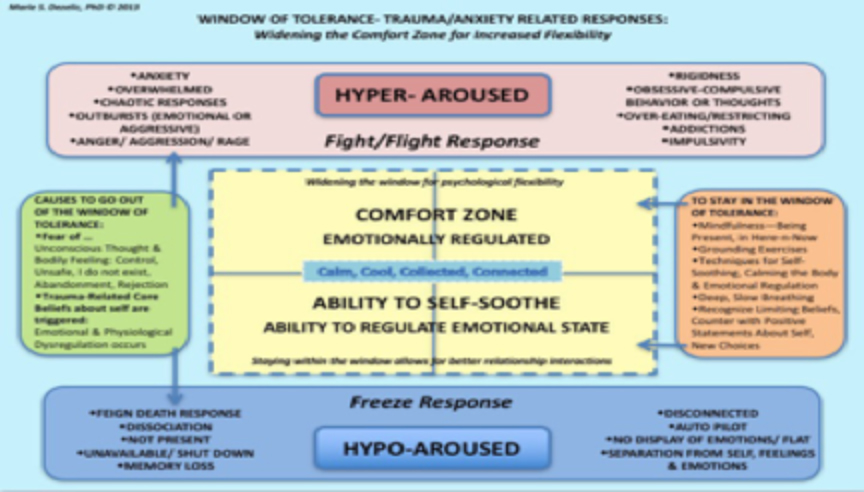
We discussed the window of tolerance, and how as we work through the things that trigger either a hyper-aroused response, or a hypo-aroused response, this window of tolerance (comfort zone on the graphic below) grows larger and larger.


As our window of tolerance grows, we are better able to stay in a regulated level of arousal, and we can return to this level of arousal more quickly and easily.

Taking Care of Others

Everybody in our lives has problems and issues, but what is important to pay attention to is whether or not they are actively and genuinely working on them. It is okay to be supportive, but always stop to ask yourself “Am I Working harder for this person than they are working for themselves?” as well as “ I am working harder for this person than I am working for myself?”

Remember: put your air mask on before helping others with theirs.

Color wheel of awareness

White= chill not focused on anything, in a safe zone

Yellow= noticing things but not focused on danger

Orange= found a threat and I am aware of it. Ex- person over there has a hand in his pocket.

Red= Found a threat, hyper focused on it.

Black= tunnel vision. Cannot see anything else. Only tunneled in on the threat.


Living in level orange or higher constantly is not good for the adrenal system. I tis likely you are going to experience physiological symptoms such as fatigue, digestive issues, headaches etc.


Boundary House

Using this blank outline of a house can help you decipher the boundaries you wish to draw with the people in your life, by visualizing how close the relationships are/ you would like them to be. Place the people in your life in either the bedroom, kitchen, living room or porch.

A general guideline:

Porch: You know this person, and may be acquainted with them but you are not going to let them into your house.

Living room: This is where you have friends come over, and you may hang out in here, but this person is not going to feel free to go rummaging through your kitchen and making themselves a snack.

Kitchen: This person is going to feel comfortable enough in your home to come in, go to your kitchen, grab themselves a snack or a drink without you doing it for them.

Bedroom: This is the most intimate of spaces, reserved for the most intimate of your relationships.


Addiction & Recovery – Boundaries

Tips and coping strategies from week 2 of the Addiction Recovery workshop with therapist Nicki Line.

Quarantine

If you are having to stay home during this time, the isolation and idleness can be a trigger for mental health problems.  Here are some ideas of emotion focused coping activities you can engage in during this time if you find yourself triggered to engage in an unhealthy coping mechanism, or simply with some time to fill:

  1. Exercise
  2. Write in a journal
  3. Draw
  4. Listen to music
  5. Take a bath
  6. Play with a pet
  7. Spend time in nature (with social distancing!)
  8. Clean the house (or a closet, drawer, or area)
  9. Read a book
  10. Meditate
  11. Use aromatherapy
  12. Facetime a friend
  13.  Cook a meal
  14. Engage in spiritual exercises
  15. Practice breathing exercises
  16. List the things you feel grateful for
  17. Color
  18. Garden
  19. Do yoga
  20. Use progressive muscle relaxation
  21. Give yourself a pep talk
  22. Watch a movie series
  23. Invent a new game
  24. Look at pictures that remind you of the people, places, and things that bring you joy
  25. Take care of your body in a way that makes you feel good (paint your nails, do your hair, put on a face mask)
  26. Use a relaxation app such as Calm
  27. Go for a walk
  28. Use Netflix’s social feature to watch a movie with friends
  29. List your goals for the next month, the next six months, the next year
  30. Call the people you are grateful for and tell them why
  31. Learn a new skill via youtube


Resiliency & Coping strategies

Coping skills can lead to resiliency. Coping skills allow us to successfully get through tough or challenging experiences. Each time we have a bad experience, and we successfully get through it unharmed, we learn that we have the ability to face the challenge. Having this happen repeatedly builds resiliency and trust in ourselves. When we confront our triggers, with the help of coping skills rather than avoiding them, we build resiliency as well.

Here is a great resource for building new healthy coping skills:

https://www.therapistaid.com/worksheets/coping-skills-addictions.pdf


Here are some resources about resiliency:

https://www.psychologytoday.com/us/blog/talking-about-men/201802/three-simple-ways-enhance-mental-health-resilience

https://positivepsychology.com/resilience-activities-exercises/


Importance of boundaries

Boundaries are SO important in our lives. They set the stage for healthy relationships of all sorts, including healthy relationships with ourselves. Setting boundaries and maintaining them can be a difficult task so here are some resources on setting and maintaining boundaries in our lives! Remember, setting boundaries and doing what you need to maintain them is not rude or selfish. You are teaching people that you respect yourself, and simply asking them to do the same.

https://www.therapistaid.com/worksheets/healthy-boundaries-tips.pdf

https://www.therapistaid.com/worksheets/setting-boundaries.pdf


Locus of Control

External locus of control= People with an external locus of control generally believe that their lives are controlled by outside forces, for example luck, fate, the actions of others, etc. They feel little sense of empowerment to make changes in their lives.

Internal locus of control= People with an internal locus of control feel that they can guide and direct their lives, and feel empowered to make positive changes.

Here are some blogs/  resources about cultivating an internal locus of control:

https://psychcentral.com/blog/cultivating-an-internal-locus-of-control-and-why-its-crucial/

https://www.verywellmind.com/develop-an-internal-locus-of-control-3144943


Social Media

We live in a social media driven world, and many of us depend on social media for work. So cutting out social media may not be feasible for all of us. However, what we can do is be more intentional about the way we use social media. This can be another example of setting boundaries. Each of us has the ability to decide and control what types of media we allow into our personal space. We can block, unfollow and mute any media that isn’t serving a positive purpose in our lives via informing us in a factual relevant way, inspiring us or motivating us. We can follow more people that inspire us, build our self esteem, motivate us, make us laugh, and give us some relief from every day life. Try to limit your social media exposure in general, and with the time you do spend on social media, make decisions about what type of media you want to influence your life. If a certain person or page consistently evoked negative emotions in you, take note! Maybe it’s time for an unfollow. This isn’t rude or unfriendly, it’s a form of self respect and asserting your right to control the things that influence you. Set those boundaries!


Links shared in the group:

https://recoverydharma.org/

https://instagram.com/clementinemorrigan?igshid=crmn7r98dotf

https://reason.com/2020/03/18/the-earn-it-act-is-the-new-fosta/


Addiction & Recovery – Codependency

Tips and coping strategies from week 1 of the Addiction Recovery workshop with therapist Nicki Line.

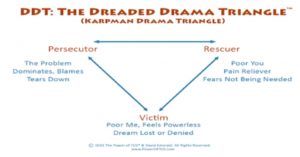
Codependency: The Drama Triangle


Victim; The stance of the victim is “poor me”. Victims see themselves as victimized or powerless. They can deny responsibility for their negative circumstances and deny possession of the power to change those circumstances. A person in the victim role will look for a rescuer to save them (and if someone refuses or fails to do that they may perceive them now as a persecutor.) Victims typically have difficulties making decision, solving problems, or understanding their self-defeating behaviors.

Rescuer: The stance of the rescuer is “let me help you!”.  Rescuers work hard to take care of other people. Rescuers may need the help of other people to feel good about themselves, while neglecting their own needs.  Rescuers are codependent in terms of needing a victim to help, and they can often feel guilty or badly about themselves if they are not actively rescuing someone. Rescuers are also considered enablers because they remove responsibility from the victim to manage their own problems. Rescuers can find themselves overworked, burnt out, and often can begin to feel resentment festering.  Often this resentment can shift a rescuer into the role of a persecutor as they feel/ express things such as “ You don’t care about anything I do for you and you never do anything for me!”.

Persecutor: The stance of the persecutor is “it’s all your fault!”.  Persecutors often criticize and blame the victim. Persecutors may use threats and criticism to keep a victim feeling oppressed.  However, their criticism usually does not help or solve any problems.

* In a codependent situation, an individual can play all three of these roles at different points in time.


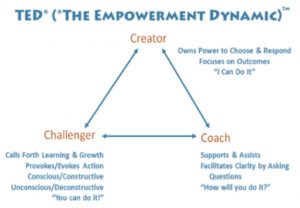
Codependency: The Empowerment Dynamic (TED)

The empowerment dynamic is the positive alternative to the drama triangle

Creator: Alternative to the victim. A creator is focused on a desired outcome, and sets goals that propel them towards their desired outcome.

Coach: Alternative to the rescuer. Uses compassion and questions to help guide a creator to developing their own vision and plan of action. Instead of stepping in and taking over as a rescuer may, a coach uses encouragement and support to help a creator put their plans into action.

Challenger: Alternative to the persecutor. A challenger is focused on learning and growth. They hold a creator accountable, but consciously builds them up and encourages them to keep moving and stay accountable to their goals.


Self Soothe Kits

Try to include something that engages each of the five senses. Some examples:

Sight: A postcard of somewhere you feel calm/ safe or somewhere you’ve always wanted to go. Photos of your favorite people. Affirmation cards.

Touch: slime or silly putty

Sound: a playlist on your phone with calming music

Taste: chocolate, citrus tastes, sour candies.

Smell: scented lotion or oils


Grounding Exercises

54321 Technique:

  1. Acknowledge 5 things you can see
  2. Acknowledge 4 things you can touch
  3. Acknowledge 3 things that you can hear
  4. Acknowledge 2 things that you can smell
  5. Recite 1 thing positive about yourself.

.

Breathing Exercise

Square breathing:

  1. Slowly exhale all your air
  2. Gently inhale through your nose to a slow count of 4
  3. Hold in for a count of 4
  4. Gently exhale through your mouth to a slow count of 4
  5. Pause and hold for a count of 4
  6. Repeat


Useful Resources


The power of TED -Book by David Emerald Womeldorff


Brene Brown The Call To Courage- Netflix special


Brene Brown various Ted Talks about vulnerability – available on YouTube


The Body Keeps the Score- book by Bessel van der Kolk