Pineapple Support and Chaturbate Co-Host Model Lounge at Venus Berlin 2026

Pineapple Support and Chaturbate teamed up once again to co-host the model lounge at Venus Berlin, which took place from October 22 to 25 at Messe Berlin.

The lounge gave creators a space to grab refreshments and take some well-earned down time away from the show floor. Pineapple Support therapists Mariia Sharygina and Bryn Powell, both specialists in working with the adult industry, were on hand throughout the weekend offering free, confidential mental health check-ins for anyone feeling stressed or overwhelmed, or who simply needed someone to talk to.

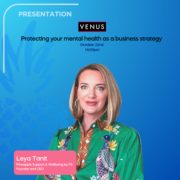
On Thursday, October 22, Pineapple Support Founder and CEO Leya Tanit delivered a featured presentation in the Business Lounge titled “Protecting Your Mental Health as a Business Strategy.” The session looked at why burnout, stigma, isolation, and mental health crises are not only personal challenges but business ones, affecting productivity, reputation, and the bottom line. Tanit shared how studios, platforms, and performers can build a culture of care, why investing in mental wellbeing is also a smart compliance move, and the practical ways Pineapple Support is already helping thousands across the industry, from free therapy to corporate training.

“Our industry is evolving fast, and the pressures on the people within it are growing just as quickly,” said Tanit. “Protecting your people is protecting your business, and the companies that understand that will be the ones that thrive. I’m proud to have been back at Venus Berlin, and grateful to Chaturbate for helping us create a space where creators could pause, recharge, and get support when they needed it.”

For more information about Venus Berlin, visit venus-festival.com.

What Happens When It All Goes Out of Control?

We never really have life under control.

I know that. You know that. We can probably all nod sagely and say something profound about accepting the things we cannot change.

But for those of us who may or may not have slight control issues, we do at least like to feel as though we are in control of our own destiny.

We make plans. We create timelines. We work out what happens next. We build a picture in our heads of how something is going to unfold.

Then life comes along and says, “Absolutely not.”

Something changes and the plan you had isn’t possible anymore. The outcome you expected suddenly looks different. Perhaps there is a solution, but it isn’t your solution. It isn’t the route you had planned, prepared for and already mentally lived through, and that can be incredibly unsettling.

For some people, particularly those of us on the autism spectrum, a sudden change of plan or loss of predictability can feel like far more than an inconvenience.

You can understand perfectly well that the world hasn’t ended while simultaneously feeling as though your entire nervous system thinks it has.

That impact can be mental, but it can also be very physical.

Your stomach turns. Your chest tightens. You can’t sleep. Your brain starts running through every possible scenario at 400 miles an hour. You struggle to concentrate on anything else because some part of you is desperately trying to put everything back where it was supposed to be.

People love to say, “Don’t focus on what you can’t control.”

Excellent advice… infuriatingly difficult to actually follow, especially when there is something you can do, but it isn’t what you wanted to do and that distinction matters.

Sometimes accepting what we cannot control doesn’t mean doing nothing. It means accepting that Plan A has gone to shit and deciding what we’re going to do with Plan B, and that can be scary.

What do you do when the plan changes?

We all respond differently. Some of us put our heads in the sand. If I don’t open the email, make the call, look at the bank account, have the conversation or make the decision, perhaps the problem will politely disappear.

Spoiler: it generally doesn’t.

Some of us go immediately into fight mode – Fix it. Now! Send the emails. Make the calls. Create seventeen spreadsheets. Find twelve possible solutions before breakfast. Do absolutely anything that might restore that feeling of control.

Neither response is particularly surprising. When something feels threatening, our nervous system wants safety, and certainty feels safe.

But sometimes there isn’t an option that feels safe, there is simply the next thing that needs to be done, and sometimes you have to do it afraid. I love that phrase because it doesn’t pretend courage means suddenly not being scared.

You might still be terrified – Do it afraid.

You might not know whether you’re making the right decision – Do it afraid.

You might desperately wish there were another option – Do it afraid.

Courage isn’t always walking confidently towards something, sometimes it’s walking towards it while every part of you would quite like to turn around and go home.

The annoying part is that putting it off rarely makes it less frightening, usually, the opposite happens. The thing sits there, it grows, your brain gives it additional heads and teeth and occasionally a flamethrower. The anticipation becomes worse than the action itself.

So, eat the frog.

Make the call.

Open the email.

Have the conversation.

Look at the numbers.

Ask for help.

Make the decision you didn’t want to have to make.

Take the first step towards Plan B.

You don’t need to feel ready first.

Control what you can. Release what you can’t.

I am still learning this bit. There are things we can control: how we respond, whether we ask for help, whether we take the next step, whether we communicate, whether we show up. Then there are the things we simply cannot – other people, timing, decisions that aren’t ours to make, unexpected changes, life doing what life does.

There comes a point when you have done what you can and then you have to release the rest. Call it acceptance, call it trust, call it putting your faith in the universe. Whatever works for you.

For me, there is something comforting in reminding myself that the route changing doesn’t necessarily mean the destination has disappeared. Maybe Plan B will be better, maybe it won’t, maybe six months from now I’ll understand why everything had to shift. Maybe I’ll still think Plan A would have been bloody preferable.

But right now, I don’t need to know how the whole story ends, I just need to do the next thing. Even if I’m scared… especially if I’m scared.

Eat the frog. Do it afraid. Control the things you can control.

And then, as much as humanly possible, let the rest go.
Pineapple Support CEO Leya Tanit to Host Mental Health Panel at CreatorConX Ibiza 2026

Pineapple Support, the adult industry’s leading mental health nonprofit, is proud to announce that CEO Leya Tanit will host a panel at CreatorConX Ibiza 2026, taking place on the 15th October at 16:15pm Titled “Coping with the Spotlight: Real Talk on Mental Health & Online Fame,” the panel will feature psychotherapist Michele Karban and creator Bonnie Locket.

CreatorConX a high-end B2B gathering, runs from 14th -17th October and is dedicated to the creator economy, uniting leading creators, global brands, platform executives, marketing and traffic specialists, tech and AI innovators, and legal and tax experts in one curated environment. Across three days of keynotes, panels, workshops, and masterclasses, around 400 top players from across the creator industry will come together for strategic networking, knowledge exchange, and partnership development.

“What does it actually feel like to live your life in public, and how do you look after your wellbeing while doing it? That’s the conversation we want to have at CreatorConX,” says Tanit. “From managing your reputation and deciding which parts of yourself to keep private, to dealing with online harassment, people who think they know you, and the constant pressure to create and stay visible, creators carry a lot. I’m thrilled to be sharing the stage with Michele Karban and Bonnie Locket for an honest conversation with practical tools people can genuinely use, and to make sure everyone in this industry knows they never have to go it alone.”

How our nervous systems affect how we navigate relationship conflict

Romantic partnerships can be places of great growth and vulnerable hardship. And a lot of those experiences come through how we communicate with our partners. For the vast majority of us, communication with our partners can be quite challenging. It’s incredibly common to find ourselves in familiar cycles of arguing, defensiveness, shutting down, or just good old-fashioned emotional withdrawal. But here’s the thing a lot of us were never taught about communication with our partners: it’s not the content that makes conversations harder, it’s how we share it that often makes the difference.To understand that concept better, we first need to understand our nervous system and brain. When we’re able to have centered, vulnerable conversations that feel more collaborative, it means our prefrontal cortex is online. But when we fall into cycles of defensiveness and shutdown, it means our amygdala has taken over, which means we’re in survival mode – fight or flight. When we enter fight or flight, we aren’t relational partners anymore; we’re mainly in self-protection mode. Why relationship conflict can take us to that survival mode really fast can be for a multitude of reasons such as our upbringing, past traumas, and social messaging about what conflict means (such as getting into trouble).There are many cues our body gives us when we’re in fight or flight. Here are some common ones:

  •   Heart racing
  •   Feeling physically fired up
  •   Defensiveness or feeling “armored up” in your body
  •  Anxiousness
  •   Dissociation such as feeling emotionally shut off or disconnected. There are many other cues as well, such as finding yourself being overly critical or dismissive, but what’s important is figuring out what your unique cues are. Once you do, the next important step is learning how to calm or regulate your nervous system so you can show up more relationally and collaboratively in those conversations.Self-regulation techniques can look like a lot of things, but some of the most common ones include:
  • Taking a step away from the conversation to get a breather
  •   Calm-place visualization
  •  Deep breathing

Moving your body or shaking out your limbs to release that fight-or-flight energyHowever you choose to self-regulate, it’s always helpful to ask for a pause in a challenging conversation so you can take a moment to calm your nerves and then make an intentional effort to return to the conversation with an emphasis on collaborating and trying to understand each other, rather than trying to win over the other. Always remember that vulnerable, hard conversations with our partners require us to lead with vulnerability instead of impenetrability

Written by: Daniel Oommen MCP, ABS, RCC
Registered Clinical Counsellor & Certified Sexologist
Pronouns: They/Them
Website: https://collective-healing.ca/team/daniel-oommen

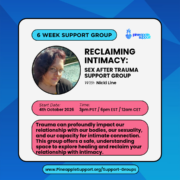
New Support Group: Reclaiming Intimacy: Sex After Trauma

Healing is possible, and your journey toward healthy intimacy matters. We’re proud to announce our newest free, online support group, “Reclaiming Intimacy: Sex After Trauma,” led by Pineapple Support therapist Nicki Line.

Trauma can have a profound impact on our relationship with our bodies, our sexuality, and our capacity for intimate connection. Whether you’re navigating the aftermath of sexual trauma, relationship abuse, medical trauma, or other experiences that have affected your sexual wellbeing, this six-week group offers a safe, understanding space to explore healing and reclaim your relationship with intimacy.

“Trauma can profoundly change our relationship with our bodies, our sexuality, and our capacity for intimate connection, but healing is possible,” says Nicki. “This group offers a safe, understanding space to explore that healing at your own pace and begin reclaiming a healthy relationship with intimacy.”

For people working in the adult industry, intimacy can be both part of the job and something deeply personal, which can make the effects of trauma feel even more complicated.

“When trauma enters the picture, that relationship can feel complicated or out of reach,” says Pineapple Support Founder and CEO Leya Tanit. “This group is about creating a space free from judgment and stigma, where people can be heard, feel less alone, and take meaningful steps toward healing alongside others who understand.”

Group Details

Start date: Sunday, October 4th
Time: 3PM PST / 6PM EST / 12AM CET
Duration: Six weeks, with weekly 60-minute sessions held online
Cost: Free

Spaces are limited. To find out more and reserve your spot, visit pineapplesupport.org/support-groups.